
How to Buy a Boat: Step-by-Step Process
Introduction
Buying a boat is one of the most rewarding purchases you can make — but it can also be one of the most complex. Unlike buying a car, purchasing a boat involves marine surveys, sea trials, escrow accounts, and a unique set of legal requirements. This guide walks you through every step of the process so you know exactly what to expect.
Step 1: Define Your Needs and Budget
Before browsing listings, be clear about how you plan to use the boat. Ask yourself:
- Where will you use it? Coastal cruising, offshore passages, inland waterways, or racing each demand different vessels.
- How many people? Day sails with two people vs. liveaboard for a family are very different requirements.
- Power or sail? Sailboats offer lower running costs and an active experience; motorboats offer speed and convenience.
- New or used? A used boat offers more value per dollar, but requires more due diligence.
Set a realistic total budget — not just the purchase price. Budget an additional 10–20% for immediate repairs, safety equipment, insurance, and the first season's mooring or marina fees.
Step 2: Research Boat Types
Once you know how you'll use the boat, narrow down the type. Common categories include:
- Sailboats — Monohulls and catamarans, ranging from day-sailors to blue-water cruisers.
- Motor yachts — Express cruisers, flybridge yachts, and trawlers.
- Center consoles — Open fishing boats with a center-mounted helm.
- Catamarans — Stable, spacious multi-hulls popular for cruising and chartering.
- Classic yachts — Heritage vessels with character, often requiring more maintenance.
Read reviews, join owner forums, and if possible, charter the type of boat you're considering before committing to a purchase.
Step 3: Search Listings and Create a Shortlist
Use listing sites to search within your budget and preferred type. When evaluating listings, pay attention to:
- Year and build quality — Reputable yards hold their value better and are easier to insure.
- Engine hours — For diesel engines, under 1,000 hours is low; over 5,000 hours warrants scrutiny. For petrol outboards, under 500 hours is typical.
- Location — Boats kept in fresh water or dry-stored often have better hull condition.
- Equipment included — Sails, electronics, safety gear, and ground tackle add real value.
- Maintenance history — Ask for service records. A well-documented history is a strong positive sign.
Create a shortlist of 3–5 boats that fit your criteria before arranging viewings.
Step 4: View the Boat in Person
Photos can be misleading. Always inspect a boat in person before making an offer. During a viewing:
- Bring a torch and check dark areas — bilges, lockers, under berths — for signs of water intrusion or rot.
- Press on deck surfaces to check for soft spots (a sign of water in the core).
- Inspect the engine visually — look for rust, oil leaks, and corrosion.
- Test all onboard systems: navigation lights, bilge pump, VHF radio, chart plotter.
- Check the standing and running rigging on a sailboat for wear.
If you're not experienced, bring along a knowledgeable friend or an independent marine consultant.
Step 5: Make an Offer
Once you've found the right boat, make a written offer. A typical offer is made via a Purchase and Sale Agreement (PSA) and should include:
- Agreed purchase price (subject to survey and sea trial)
- A deposit (usually 10%) held in escrow
- A timeline for the survey and sea trial (typically 7–14 days)
- What is included in the sale (equipment list)
- Conditions under which you can withdraw and receive your deposit back
The seller may counter-offer, and negotiation typically takes a few days before both parties sign.
Step 6: Arrange a Marine Survey
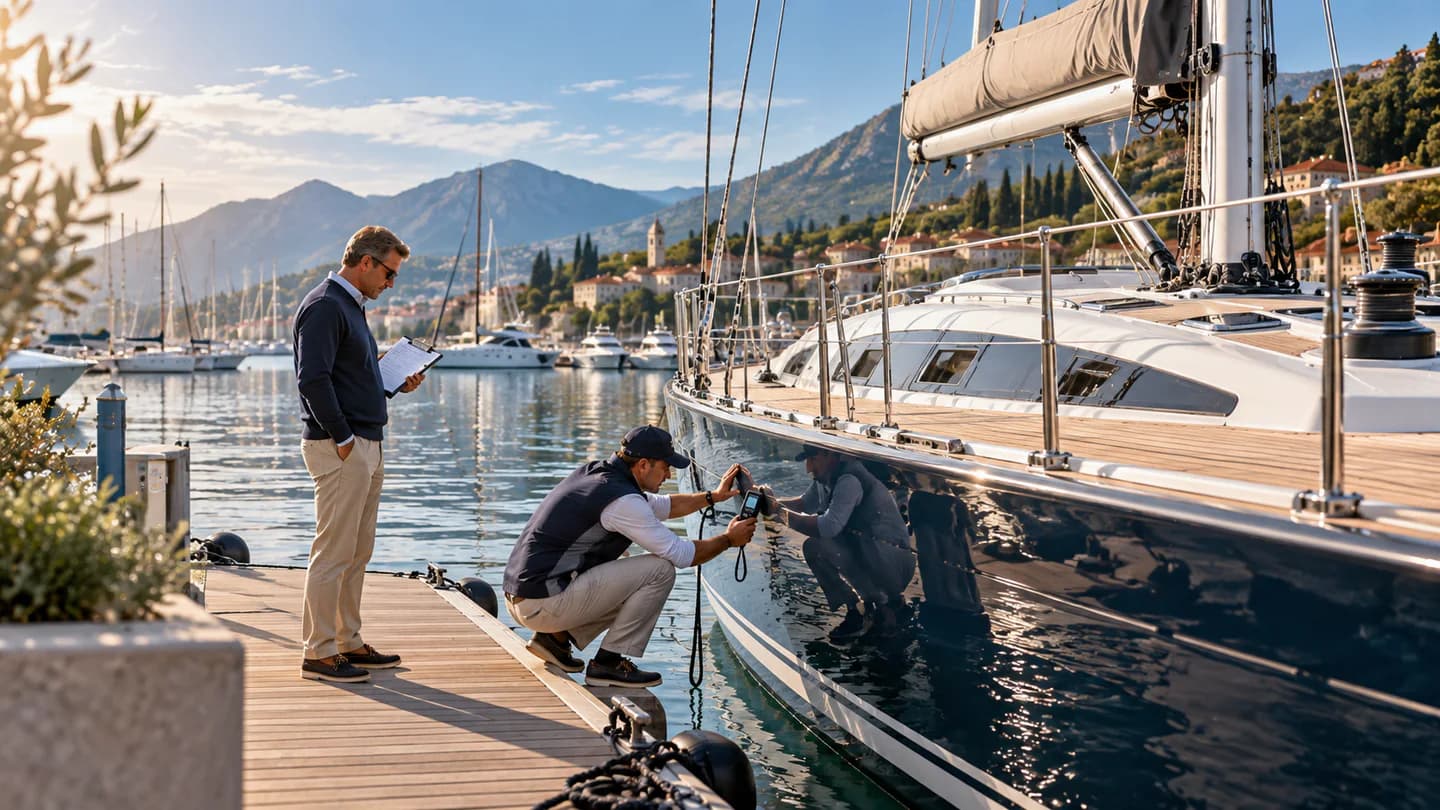
A marine survey is the equivalent of a building inspection — it's a professional assessment of the boat's condition. Always commission an independent survey, even for newer boats.
Choose a surveyor accredited by a recognised body such as IIMS, RINA, or SAMS. The surveyor will inspect:
- Hull integrity (including osmotic blistering for GRP hulls)
- Structural components — keel, frames, bulkheads
- Deck hardware and through-hulls
- Electrical systems and safety equipment
- Engine and propulsion systems
The buyer pays for the survey (typically £500–£2,000 depending on size). The boat is usually hauled out of the water for inspection. The written survey report gives you negotiating power and is required by most insurers.
Step 7: Sea Trial
The sea trial lets you verify the boat performs as expected under power (and under sail, for sailboats). During the sea trial:
- Run the engine(s) at various RPM settings and check for unusual vibration or smoke.
- Test manoeuvring at slow speed in and out of a berth.
- Check all electronics while underway (chart plotter, autopilot, instruments).
- On a sailboat, hoist sails and check for wear on battens, slides, and leech lines.
- Test the anchor windlass and deck gear under load.
The surveyor often attends the sea trial to observe the engine and systems in operation.
Step 8: Negotiate Based on Survey Findings
Once you have the survey report, you have three options:
- Accept the boat as-is — Proceed at the agreed price.
- Negotiate a price reduction — Based on repair costs identified in the survey.
- Walk away — If the issues are too serious, withdraw and recover your deposit.
Most transactions involve some negotiation at this stage. The survey report is your evidence — use it constructively.
Step 9: Closing — Payment and Transfer
Once both parties agree on the final price:
- The balance is paid — usually via bank transfer or through an escrow service.
- A Bill of Sale is signed by both parties.
- The seller provides a clear title or deletion certificate confirming no outstanding liens.
- Any existing finance on the boat must be settled before transfer.
For larger transactions, using a yacht broker or maritime solicitor to handle the closing provides additional protection for both parties.
Step 10: Registration, Insurance, and Getting Underway
After purchase, take care of the administrative requirements before leaving the dock:
- Registration — Register the vessel in your name with the relevant authority (e.g., Part I or Part III Registry in the UK; USCG or State registration in the US).
- Insurance — Marine insurance is essential. Provide the insurer with your survey report for an accurate quote.
- Safety equipment — Check that all required safety gear (life jackets, flares, fire extinguishers, EPIRB) is in date and meets regulations for your sailing area.
- Crew training — If you're new to boating, consider an RYA or US Sailing course before your first passage.
Working With a Yacht Broker
A licensed yacht broker can simplify every step of this process — from shortlisting boats and negotiating offers to handling paperwork and escrow. Broker fees are typically paid by the seller (usually 8–10% of the sale price), so using a broker costs the buyer nothing directly.
Look for a broker who is a member of the YBAA, BMF, or ABYA and specialises in the type of yacht you're seeking.
Summary Checklist
- ✔ Define use case, budget, and boat type
- ✔ Research and shortlist 3–5 boats
- ✔ View in person, check condition thoroughly
- ✔ Make a written offer with escrow deposit
- ✔ Commission an independent marine survey
- ✔ Complete a sea trial
- ✔ Negotiate based on survey findings
- ✔ Close — Bill of Sale, clear title, payment
- ✔ Register, insure, and equip the vessel