
Boat Types Explained
Introduction
Choosing the right type of boat is the most important decision in any purchase. Different types are optimised for different uses — offshore cruising, coastal daysailing, fishing, fast passage-making, or living aboard. Understanding how boat types differ helps you narrow your search to vessels genuinely suited to your plans.
Browse listings by type directly: Sailboats · Motorboats · Catamarans
Sailboats
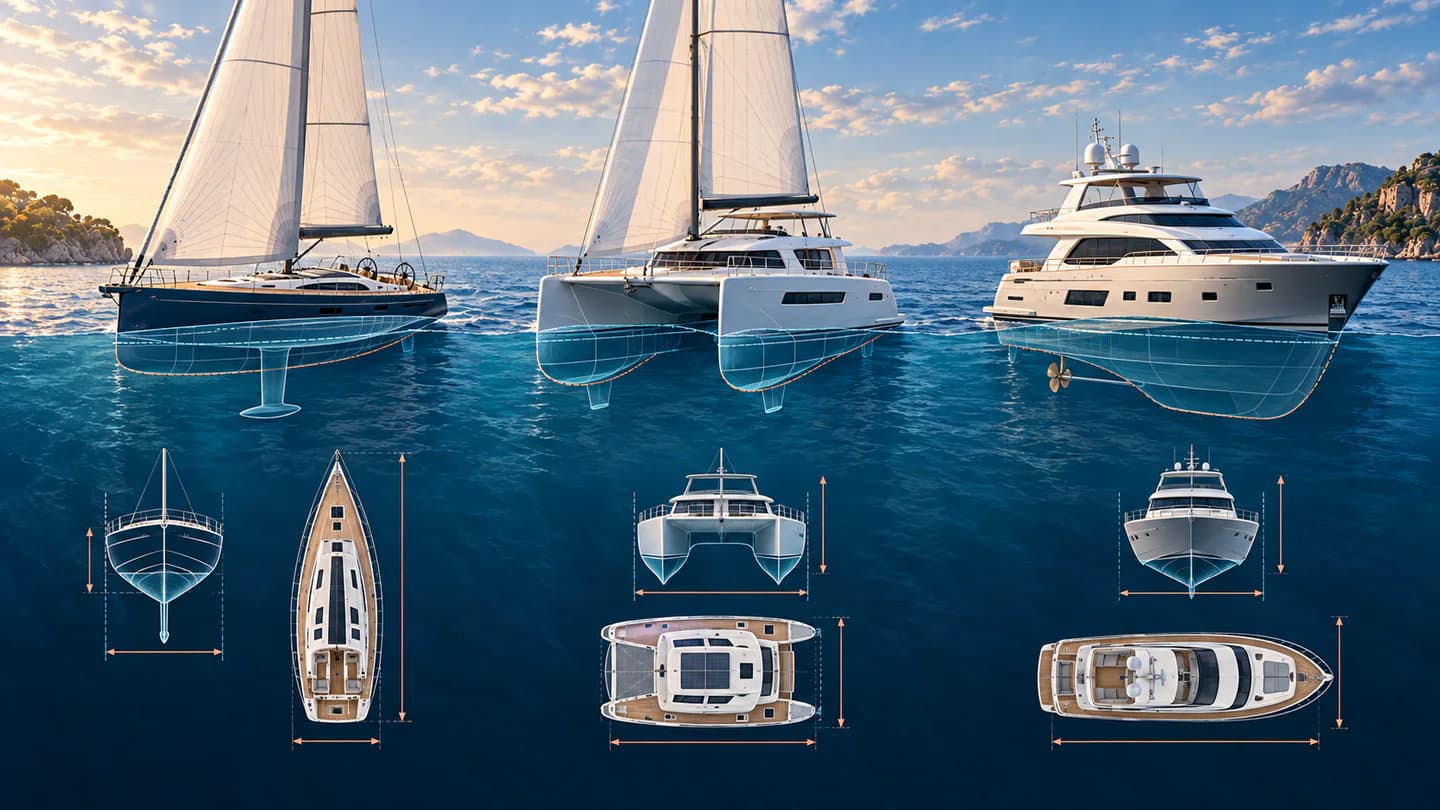
A sailboat is any vessel whose primary means of propulsion is wind, captured by sails. Almost all modern cruising sailboats also carry a diesel auxiliary engine for use in calm conditions, entering harbour, and charging batteries. Sailboats are categorised both by their hull configuration (monohull or multihull) and their rig type (sloop, ketch, cutter, etc.).
Best for: Offshore passage-making, liveaboard cruising, racing, coastal cruising on a lower fuel budget.
Key advantages: Long-range capability on wind alone, lower running costs than motorboats of equivalent size, an active and rewarding sailing experience.
Key considerations: Slower than motorboats of comparable size; requires sailing knowledge; rigging adds maintenance complexity.
Motorboats
A motorboat — or powerboat — is propelled entirely by one or more engines. The category covers an enormous range, from small open runabouts to large flybridge motor yachts capable of ocean crossings. Motorboats prioritise speed, comfort, and convenience over the efficiency of sail.
Best for: Weekend cruising, entertaining, fishing, fast coastal passages, buyers who want to arrive rather than sail.
Key advantages: Fast, easy to operate, excellent visibility from a flybridge, large deck and living spaces relative to length.
Key considerations: High fuel costs at speed; range is limited by tank capacity; noisy compared to sailing under canvas.
Catamarans
A catamaran is a multi-hulled vessel with two parallel hulls of equal size. The beam (width) is significantly greater than a monohull of equivalent length, providing exceptional stability, a large deck area, and spacious twin-cabin accommodation in each hull. Sailing catamarans are the fastest-growing segment of the cruising market; motor catamarans offer comfort and shallow draft.
Best for: Family cruising, liveaboard use, charter, sheltered anchorages and shallow water (shoal draft), passage-making in trade wind conditions.
Key advantages: Stable platform (reduced seasickness), large living space, shallow draft allows access to anchorages a deep-keel monohull cannot reach, fast on a reach in trade winds.
Key considerations: Wide beam limits marina berth options (wider berth = more expensive); less comfortable upwind in a chop than a well-found monohull; more expensive per foot than equivalent monohulls.
Monohull Sailboats
A monohull is the traditional single-hull sailing vessel. The vast majority of sailing yachts sold worldwide are monohulls. They range from 20-foot trailerable daysailers to 60-foot bluewater passage-makers. Monohulls heel (tilt) when sailing upwind — a characteristic that some find disorienting but experienced sailors regard as entirely normal and manageable.
Best for: Offshore passages, racing, coastal cruising, buyers who value a wide choice of berths and simpler marina logistics.
Key advantages: Excellent upwind performance, comfortable marina berthing (standard berth width), stronger second-hand market with more choice at every price point.
Motor Yachts
Motor yachts are larger, often fully enclosed powerboats designed for extended cruising or liveaboard use. Common sub-types include:
- Express cruiser — Sporty open design, fast, ideal for day and weekend use.
- Flybridge yacht — Enclosed lower helm and a raised open flybridge above. Excellent visibility, popular for Mediterranean and Caribbean cruising.
- Trawler / displacement motor yacht — Slower, fuel-efficient hull designed for long-range ocean passages. Full-displacement hull runs at 8–10 knots on modest fuel consumption.
- Sport fishing boat — Large, powerful, equipped for offshore sport fishing with fighting chairs, outriggers, and fish holds.
Center Console Boats
A center console is an open powerboat with the helm mounted in the center of the deck rather than at the stern or in an enclosed cabin. This configuration gives 360-degree deck access — ideal for fishing, water sports, and short coastal passages. Most center consoles carry outboard engines on the transom.
Best for: Fishing, water sports, day cruising in sheltered waters, trailering.
Key considerations: Open to the elements; no enclosed shelter; not suited to extended offshore passages or overnight use.
RIBs (Rigid Inflatable Boats)
A RIB has a rigid fibreglass or aluminium hull with inflatable rubber tubes forming the sides (buoyancy tubes). The combination gives exceptional buoyancy, stability, and load capacity relative to size, with a softer ride than a hard-sided boat of equivalent beam. RIBs are used as tenders for larger yachts, for diving operations, coastal patrol, and as fast leisure craft.
Best for: Yacht tender, coastal day use, diving, water sports.
Trimarans
A trimaran has three hulls — a central main hull and two smaller outrigger hulls (amas). Trimarans offer extreme speed potential (racing trimarans hold offshore speed records) with a more manageable beam than a catamaran. Cruising trimarans are less common than catamarans but are valued for their performance and ability to fold the outriggers for marina berthing.
Classic and Traditional Vessels
Classic yachts — gaff-rigged cutters, wooden ketches, traditional pilot cutters, and heritage motor vessels — occupy their own niche. They are often bought for their character, beauty, and history rather than performance. Ownership requires accepting higher maintenance demands and the specialist knowledge needed to care for timber construction, traditional rigging, and older engine systems. Pre-purchase surveys of classic vessels should always be carried out by a surveyor with specific experience in traditional construction.
Choosing the Right Type for You
Use these questions to guide your choice:
- Where will you use it? Ocean passages favour a well-found monohull or long-range motor yacht; Mediterranean hopping suits a catamaran or flybridge; coastal daysailing opens the full range.
- How many people? A catamaran's separate cabin-per-hull layout suits couples and families who value privacy. A monohull's communal saloon suits a social sailing group.
- Do you want to sail or arrive? If sailing is the point, a sailboat. If the destination is the point, a motorboat.
- What is your budget for running costs? Sailboats and displacement motorboats are far cheaper to run than fast planing powerboats.
- Where will it be berthed? Wide catamarans and trimarans attract wide-berth surcharges at most marinas.
Once you've identified your type, read our guide on how to read a boat listing to understand the key specifications for each vessel type.