
Hull Types Explained
Introduction
The hull is the most fundamental part of any boat — its shape determines how the vessel moves through water, how fast it can go, how fuel-efficient it is, and how it behaves in rough seas. Understanding hull types helps you interpret listing specifications, compare boats meaningfully, and choose a vessel suited to your intended use.
For an overview of how boat types (sailboat, motorboat, catamaran) differ beyond the hull, see our Boat Types Explained guide. For hull dimensions such as beam and draft, see Understanding Boat Dimensions.
The Two Fundamental Hull Modes
Before looking at specific shapes, it helps to understand the two fundamental modes in which a hull can move through water:
Displacement Mode
A displacement hull displaces water — it pushes water aside and sits in it, supported by buoyancy. Displacement hulls have a theoretical maximum speed governed by their waterline length, known as hull speed: approximately 1.34 × √(LWL in feet) knots. A 36-foot waterline boat has a hull speed of around 8 knots. Attempting to push beyond hull speed requires exponentially increasing power — displacement hulls are not designed to go faster.
Characteristics: Efficient at low to moderate speeds, comfortable motion in a seaway, excellent range, lower engine power requirements.
Found on: Traditional sailing yachts, trawler-style motor yachts, long-range passage-makers.
Planing Mode
A planing hull rises up onto the surface of the water at speed, skimming across rather than pushing through. Planing overcomes the hull speed limitation and allows much higher speeds — a planing powerboat running at 30 knots is not unusual. The trade-off is high fuel consumption and a rougher ride in a chop.
Characteristics: High top speed, high fuel consumption, can be uncomfortable in head seas, limited range at high speed.
Found on: Sports boats, centre consoles, express cruisers, RIBs.
Semi-Displacement
A semi-displacement hull is a compromise: it operates in displacement mode at low speeds but can achieve a partial plane at higher power, reaching speeds beyond theoretical hull speed without fully lifting onto the plane. Offers moderate speed with moderate fuel economy.
Found on: Mid-range motor yachts, lobster boats, some sportfishers.
Common Hull Shapes
V-Bottom (Deep-V)
The most common hull shape for planing powerboats. The sharp V entry cuts through waves cleanly, providing a softer, drier ride at speed compared to flat or shallow-V hulls. The V angle (deadrise) varies from the bow to the transom — deeper deadrise at the bow for wave entry, shallower at the stern for planing efficiency.
Deadrise angle: Deep-V hulls have 18–24° of deadrise at the transom. Higher deadrise = softer ride but more fuel consumption.
Best for: Offshore powerboating, sportfishing, high-speed cruising in open water.
Flat Bottom
Simple, inexpensive to build, and highly efficient for light loads in calm, sheltered water. Flat-bottom boats plane easily at low power. However, they slam badly in a chop and are unsuitable for open-water use.
Best for: Rivers, inland waterways, sheltered bays, fishing skiffs.
Round Bilge
A round-bilge (or round-bottom) hull has a smooth, curved transition from the keel to the topsides. This shape provides the most comfortable motion in a seaway — the hull rolls smoothly rather than slamming. It is the preferred shape for traditional sailing yachts and long-range displacement motor vessels.
Best for: Bluewater sailing, long-range motor cruising, traditional and classic vessels.
Fin Keel (Sailboats)
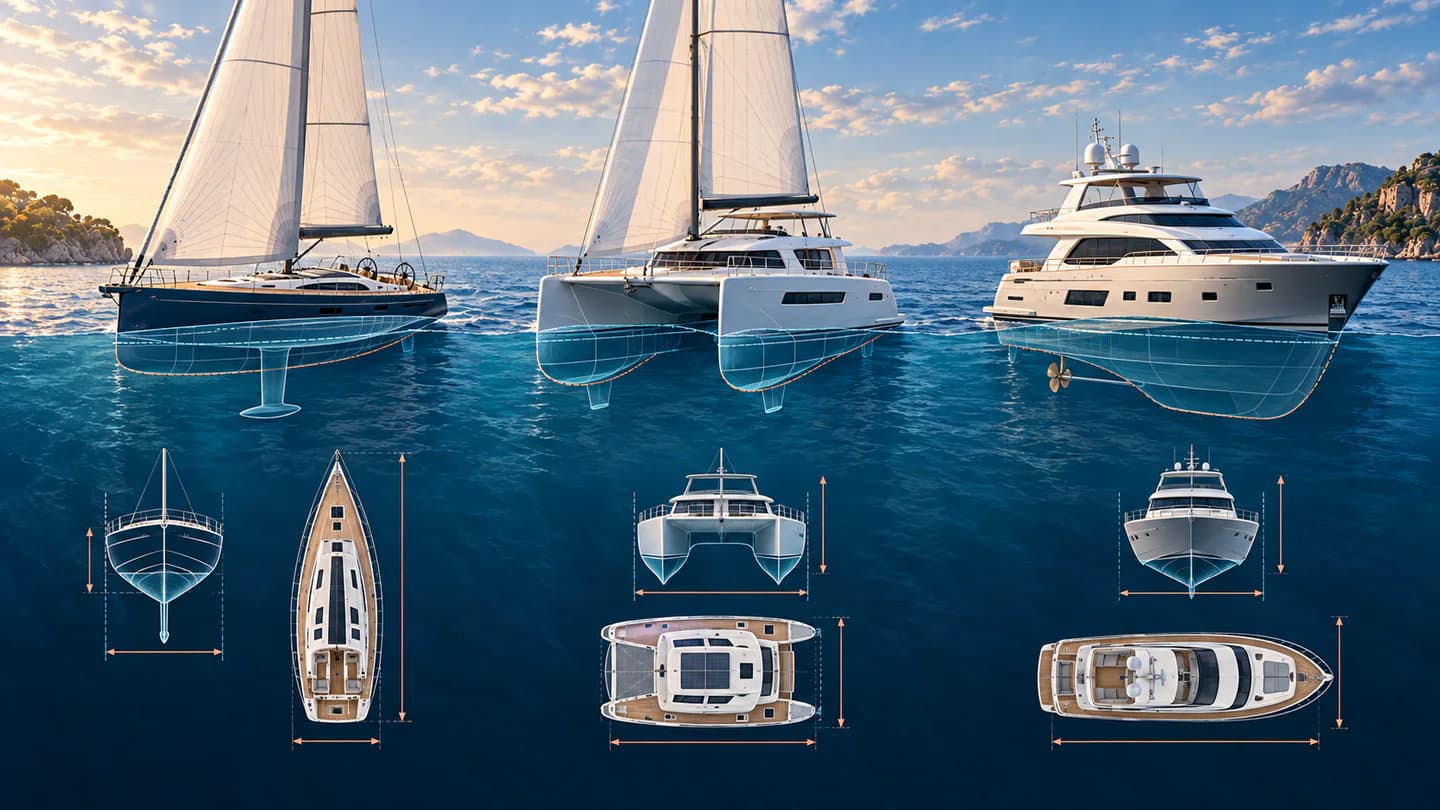
Modern performance sailboats typically have a fin keel — a narrow, deep appendage bolted below the hull carrying most of the ballast at its tip (often as a lead bulb). The fin provides lateral resistance (stopping the boat from sliding sideways when sailing upwind) and stability via its heavy ballast.
Advantages: Superior upwind performance, lower wetted surface area, better light-air performance.
Considerations: Deep draft restricts access to shallow anchorages; can be vulnerable in a grounding.
Twin-Keel / Bilge Keel (Sailboats)
Two shorter keels set apart on the lower quarters of the hull. The boat can dry out upright on the bottom at low tide — invaluable in tidal areas like the UK's east coast or Brittany. Shallower draft than a fin keel.
Advantages: Shallow draft, can dry out upright, good access to tidal harbours and drying moorings.
Considerations: Less efficient upwind than a fin keel; slightly slower in light airs.
Full Keel (Sailboats)
A traditional hull form where the keel extends along most of the hull length. The full keel provides directional stability (tracks a straight course with minimal helm input) and protects the propeller and rudder. Favoured for blue-water ocean passage-making.
Advantages: Extremely seakindly, self-steering capability, good directional stability, protected rudder and prop.
Considerations: Heavy, slower than fin-keel designs, manoeuvres sluggishly at low speed.
Catamaran Hulls
Catamarans have two narrow, slender hulls connected by a wide beam (crossbeam). Each hull generates minimal wave-making resistance because they are slim — this is why catamarans can be very fast on a reach. The wide separation of the hulls provides inherent stability; a catamaran does not need a heavy ballast keel to stay upright (it relies on beam for stability instead).
Advantages: High stability, large deck area, shallow draft, fast on a beam reach, large interior volume.
Considerations: Wide beam (marina cost and availability), different motion pattern (snap roll in a beam sea), bridgedeck clearance affects comfort in steep chop.
See our catamaran listings for examples.
What to Look for in a Listing
Listings on our platform include hull material, beam, and draft. When reading these alongside hull type:
- GRP (fibreglass) — The most common modern hull material. Check for osmosis on older hulls (raised blisters on the underwater surface). Covered in our marine survey guide.
- Steel — Strong and repairable, favoured for long-range passage-makers. Requires excellent corrosion protection; rust is the main enemy.
- Aluminium — Lighter than steel with good corrosion resistance. Common on performance cruisers and expedition vessels.
- Wood (traditional) — Beautiful and repairable but labour-intensive to maintain. Requires a surveyor with specific expertise in timber construction.
- Ferro-cement — Older construction method. Difficult to assess structurally; most surveyors and insurers treat these with caution.
For a full guide to reading listing specifications, see How to Read a Boat Listing.