
Understanding Boat Dimensions
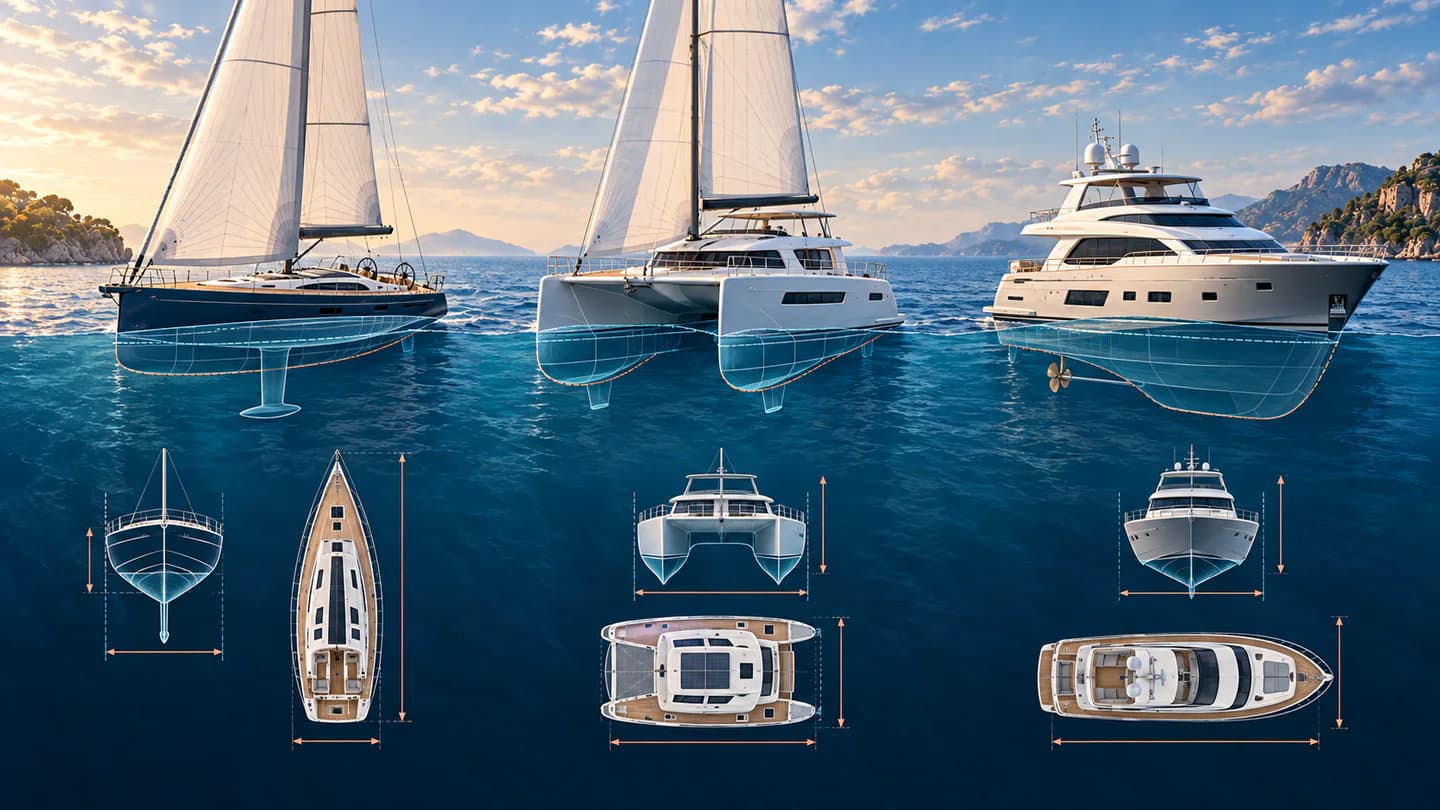
Introduction
Boat listings contain a set of standard dimensions that describe the physical size and shape of the vessel. These numbers are not just statistics — they affect where you can sail, where you can berth, how the boat performs, and how comfortable life aboard will be. This guide explains each dimension in plain language so you can compare listings accurately.
For how displacement relates to performance and seakeeping, see our companion guide What Is Boat Displacement and Why It Matters. For hull shape and its implications, see Hull Types Explained.
LOA — Length Overall
LOA (Length Overall) is the total length of the boat from the foremost fixed point of the bow to the rearmost fixed point of the stern. This is the number used for:
- Marina berth allocation and pricing (berths are charged by LOA)
- Insurance premium calculation
- Lift-out and haul-out charges at boatyards
- Race handicap calculations
When a listing simply says "length" without further qualification, it almost always means LOA. If a boat has a bowsprit, a swim platform, or a transom-mounted davits, these may or may not be included in the stated LOA depending on whether they are fixed or removable — always check before booking a berth.
LWL — Length at Waterline
The Length at Waterline (LWL) is the length of the hull measured at the water's surface. LWL is almost always shorter than LOA because most hulls have overhangs at the bow and/or stern that extend beyond the waterline.
LWL is significant for two reasons:
- Hull speed — A displacement hull's theoretical maximum speed is determined by its waterline length. The formula is approximately 1.34 × √(LWL in feet) knots. A boat with a 36-foot waterline has a hull speed of about 8 knots. A longer LWL means a higher hull speed.
- Seakeeping — Longer LWL generally means a more comfortable motion in a seaway, as the hull spans more of the wave period.
Modern race-oriented designs have minimised bow and stern overhangs, making LOA and LWL nearly identical. Traditional designs (like a classic British offshore racer) may have significant overhangs where LOA is notably longer than LWL.
Beam
Beam is the maximum width of the boat at its widest point. A wider beam provides:
- More interior volume — a beamy boat has a wider saloon, galley, and cabins
- More deck space — important for comfortable outdoor living
- Initial stability — a wider hull resists initial heeling more than a narrow one (though ultimate stability is determined by the keel for sailboats)
The trade-off is marina cost and practicality. Most marinas allocate berths by LOA but charge extra for beam over a certain threshold (often 4 metres for typical berths). Catamarans — with beams of 7–9 metres on a typical 45-foot cruising cat — attract significant wide-beam surcharges and are excluded from some marinas entirely.
For sailboats, a wider beam also affects sail trim — wider boats have a longer traveller and different sheeting angles.
Draft
Draft is the vertical distance from the waterline down to the lowest fixed point of the boat — the bottom of the keel on a sailboat, or the lowest point of the hull on a powerboat. Draft determines the minimum depth of water needed to float the boat.
Draft is one of the most practically important dimensions in a listing:
- A boat with a 2.1m draft cannot enter a harbour, marina, or anchorage with less than approximately 2.4m of water at the relevant state of tide (allowing a safety margin).
- Much of the UK's east coast, the Solent, the Wadden Sea, and large areas of the Bahamas and Florida are accessible only to boats with draft under 1.5m.
- Tidal anchorages that dry at low water — common in the UK and Brittany — require a boat that can rest on the bottom safely (bilge keels, twin keels, or a boat with a flat hull section).
For sailboats, draft is a direct function of keel type (see Understanding Keel Types). Fin keels are deepest; bilge keels and lifting keels offer shoal draft options.
Air draft is sometimes also listed — the height from the waterline to the highest fixed point (usually the masthead). Air draft determines whether a boat can pass under bridges. For masted sailboats, air draft can exceed 20 metres.
Displacement
Displacement is the weight of the vessel — specifically, the weight of water that the hull displaces when floating. By Archimedes' principle, this equals the total weight of the boat (hull, rig, engine, fuel, water, stores, and crew). Displacement is expressed in kilograms or metric tonnes (1 tonne = 1,000kg).
For a full explanation of what displacement means for performance and seakeeping, see our dedicated guide: What Is Boat Displacement and Why It Matters.
Freeboard
Freeboard is the vertical distance from the waterline to the top of the deck (the gunwale or toerail). High freeboard gives:
- More headroom in cabins below the waterline — important for liveaboard comfort
- Greater reserve buoyancy — the boat can heel further before water reaches the deck
- More volume for interior accommodation
Low freeboard gives a sleeker profile and easier boarding from the water, but reduces interior headroom and makes the boat wetter in a seaway. Traditional offshore racing yachts and fast modern performance cruisers tend to have lower freeboard; liveaboard-oriented production boats tend to be higher-sided.
Freeboard is rarely listed as a number in a specification but can be assessed from photos and is worth considering when evaluating how a boat will be to use in practice.
Ballast
For sailboats, ballast is the weight of the keel — the heavy material (usually lead or iron) that counteracts the heeling force of the sails and keeps the boat upright. Ballast is not the same as displacement; it is a component of it.
The ballast-to-displacement ratio expresses what proportion of the total weight is ballast:
- Low ratio (under 30%) — Light-displacement racer or multihull. Stability relies more on beam than ballast.
- Mid ratio (30–40%) — Typical production cruiser. Good balance of performance and stability.
- High ratio (40%+) — Heavy-displacement bluewater boat. Very stable, self-righting in extreme conditions, but slower in light air.
Tank Capacities
Fuel and water tank capacities are practical dimensions that directly affect range and self-sufficiency:
- Fuel capacity (litres) — Combined with engine fuel consumption at cruise speed, gives theoretical motoring range. For a diesel cruising yacht burning 3 litres/hour at 6 knots with a 120-litre tank: range = (120 ÷ 3) × 6 = 240 nautical miles.
- Water capacity (litres) — At 5–10 litres per person per day, a 200-litre tank supports two people for 10–20 days without refill. For offshore passages, a watermaker (desalinator) supplements tank capacity.
Reading Dimensions in Listings
When comparing two boats of the same LOA, check:
- Beam — A beamier boat has more interior volume but costs more to berth
- Draft — Critical for your intended sailing ground
- Displacement — Heavier boats are typically more seakindly; lighter boats faster in light air
- Fuel capacity — Especially for motorboats, where range is fuel-limited
Our listing search lets you filter by boat type and region — see all current listings at Browse all boats. For guidance on interpreting the full specification of a listing, read How to Read a Boat Listing.