
Understanding Keel Types
Introduction
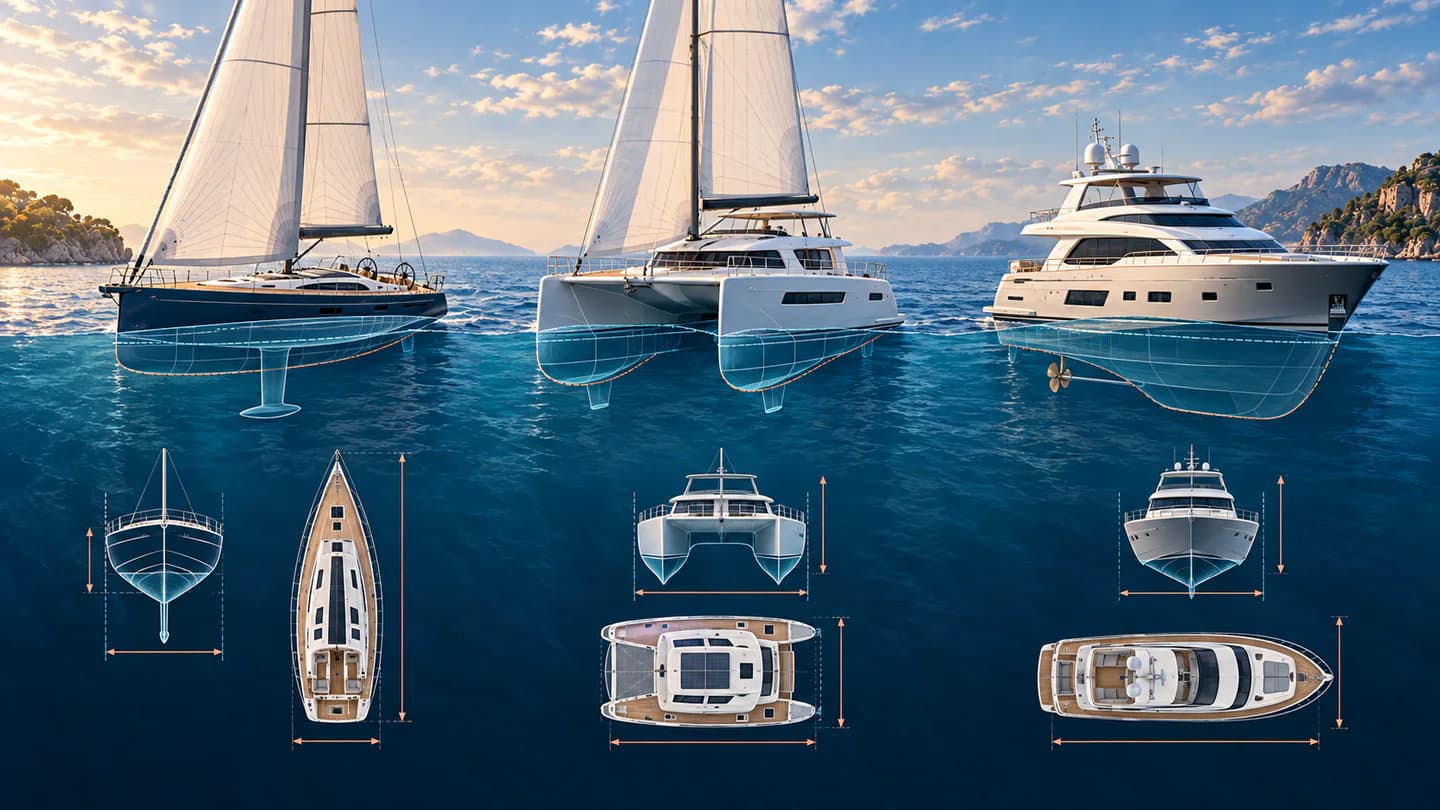
The keel is the structural and hydrodynamic backbone of a sailing yacht. It serves two fundamental purposes: providing lateral resistance (stopping the boat from sliding sideways when sailing upwind) and carrying ballast (the heavy weight — usually lead or iron — that keeps the boat upright against the force of the wind in the sails). The shape, depth, and weight distribution of the keel profoundly affect a boat's performance, handling, and the waters it can access.
Keel type is typically listed in the specification section of every sailboat listing on our platform. For context on how keel type interacts with draft, see Understanding Boat Dimensions. For the full sailboat listing specification, see How to Read a Boat Listing.
Browse sailboat listings to see keel types across the market.
Fin Keel
The fin keel is the dominant design on modern production sailing yachts. It consists of a narrow, vertical appendage — the fin — bolted to the bottom of the hull, with the ballast concentrated at or near the bottom of the fin, often as a hydrodynamic lead bulb.
The fin keel design emerged as racing yacht research demonstrated that concentrating ballast as deep as possible (to maximise the righting moment) and minimising wetted surface area (to reduce drag) produced faster, more efficient sailing. Modern production cruisers from Jeanneau, Beneteau, Bavaria, Hanse, and Hallberg-Rassy all use fin keel variants.
Standard Fin Keel
- Draft: typically 1.8–2.2m for a 40-foot boat
- Excellent upwind performance and pointing ability
- Lowest wetted surface area — least drag
- Best light-air performance
- Restricts access to shallow waters (tidal harbours, many anchorages)
- Vulnerable to grounding damage — a solid hit on the keel can damage the keel-to-hull join
Bulb Keel
A variation where the ballast is concentrated in a hydrodynamic torpedo-shaped bulb at the foot of the fin. The bulb places maximum weight at the lowest point, maximising the righting lever without requiring a very long fin. Common on performance cruiser-racers.
Shoal Draft Fin Keel
A shorter, wider fin keel that provides reduced draft (typically 1.2–1.5m) while maintaining reasonable upwind performance. The trade-off is some loss of efficiency compared to a deep fin, but access to significantly more anchorages and harbours. Many modern production boats are offered with a choice of standard or shoal draft keel options.
Bilge Keel (Twin Keel)
Bilge keels are two shorter keels set at an angle on the lower quarters of the hull (one on each side). The boat rests upright on both keels when the tide dries. This configuration is uniquely valuable in tidal environments where drying out (the tide leaving the boat sitting on the seabed) is common practice.
Bilge keels are strongly associated with UK sailing — the tidal nature of many UK anchorages, harbours, and drying moorings makes bilge keel boats particularly practical for sailors based in the Solent, East Anglia, the West Country, the West Coast of Scotland, and Brittany.
- Draft: typically 0.9–1.4m — shallower than equivalent fin keel
- Can dry out upright on the bottom (tidal moorings, drying anchorages)
- Access to harbours and anchorages closed to deep-draft boats
- Wider choice of moorings in tidal areas (often cheaper than marina berths)
- Slightly less efficient upwind than a fin keel of equivalent depth
- Higher wetted surface area — marginally slower in light air
- Hull must be inspected between the keels during a survey — a common area for osmosis and stress cracking
For buyers intending to sail the UK, Ireland, or Brittany extensively, bilge keels are worth serious consideration.
Full Keel
The full keel runs along most of the length of the boat's bottom, rather than as a separate appendage. The rudder is typically attached to the trailing edge of the keel. This is the traditional design found on classic yachts, traditional pilot cutters, Colin Archer designs, and many offshore passage-makers built before the 1970s.
- Excellent directional stability — tracks a straight course with minimal helm input, reducing autopilot load on long passages
- Very seakindly motion — the long, heavy keel damps rolling and pitching
- Protects the propeller and rudder — both are enclosed within the keel profile
- Can take the ground without damage on a soft bottom
- Heavy and slow — full keel boats are not performance-oriented
- Poor manoeuvrability at low speed — a wide turning circle and poor reverse handling
- High wetted surface area — uncomfortable in light air for extended periods
Full keel designs are valued by bluewater sailors undertaking ocean passages who prioritise self-steering ability, seakindliness, and robustness over speed. They require the right mindset — accept the pace and enjoy the journey.
Lifting Keel (Centreboard)
A lifting keel can be raised partially or fully into a casing in the hull, dramatically reducing draft when needed and restoring it for upwind sailing. The mechanism is typically hydraulic (on larger boats) or a simple tackle on smaller vessels.
- Draft range: e.g., 0.8m (keel up) to 2.2m (keel down) on a typical 42-foot cruiser
- Access to shallow anchorages and tidal harbours not possible with a fixed keel
- Full windward performance when the keel is deployed
- Can beach or take the ground in shallow water
- The keel mechanism adds complexity and requires maintenance
- The keel casing takes up interior space (typically in the saloon)
- Hydraulic systems require servicing; lifting keel pivots and pins require inspection
- Most suitable for shoal-draft sailing grounds (Bahamas, Caribbean, Nordic archipelago)
Lifting keel designs are offered by builders such as Southerly, Garcia, and Boreal, and are popular with sailors who cruise diverse destinations requiring flexibility in draft.
Daggerboard
A daggerboard is a vertical board that slides straight down through the hull rather than pivoting like a centreboard. It provides excellent lateral resistance in the down position and completely eliminates appendage drag when fully retracted. Common on racing dinghies, high-performance catamarans, and some ocean racing multihulls.
On cruising catamarans, daggerboards are standard — each hull has one, providing the lateral resistance that the narrow catamaran hulls alone cannot supply. Daggerboards require careful operation in shallow water (a high-speed grounding with a daggerboard down can be dramatic) but give catamarans excellent windward ability.
Keel Material
Most modern keels use cast lead as ballast — it is dense, corrosion-resistant, and can be cast into precise hydrodynamic shapes. Some production boats use iron keels (cheaper to manufacture but more prone to surface rust, which stains the hull). High-performance racing keels may use internal lead with a carbon fibre fin for minimum weight and maximum depth. When inspecting a boat, check for rust streaking around the keel bolts (inside the boat) and cracking at the keel-to-hull join, which indicates stress or keel movement — both are covered in our marine survey guide.
Choosing a Keel Type
The right keel type depends on where you sail:
- Offshore and ocean passages — Standard fin or bulb keel; performance and stability are the priorities.
- UK, Ireland, Brittany, tidal rivers — Bilge keel for drying access, or shoal draft fin keel.
- Mediterranean, Caribbean, trade wind routes — Standard fin or lifting keel; shallow draft useful for island anchorages.
- Traditional or bluewater cruising — Full keel for seakindliness and self-steering characteristics.
- Shallow anchorages, Bahamas, Scandinavia — Lifting keel for maximum flexibility.