
What Is Boat Displacement and Why It Matters
Introduction
Displacement is one of the most important — and most misunderstood — figures in a boat listing. It is not simply a measure of size. Displacement determines how the boat moves through water, how it behaves in a seaway, and what performance to expect in different conditions. Understanding it helps you choose a boat that matches your intended use, not just your preferred aesthetic.
For the related dimensions of beam, draft, and LOA, see Understanding Boat Dimensions. For how hull shape interacts with displacement, see Hull Types Explained.
What Is Displacement?
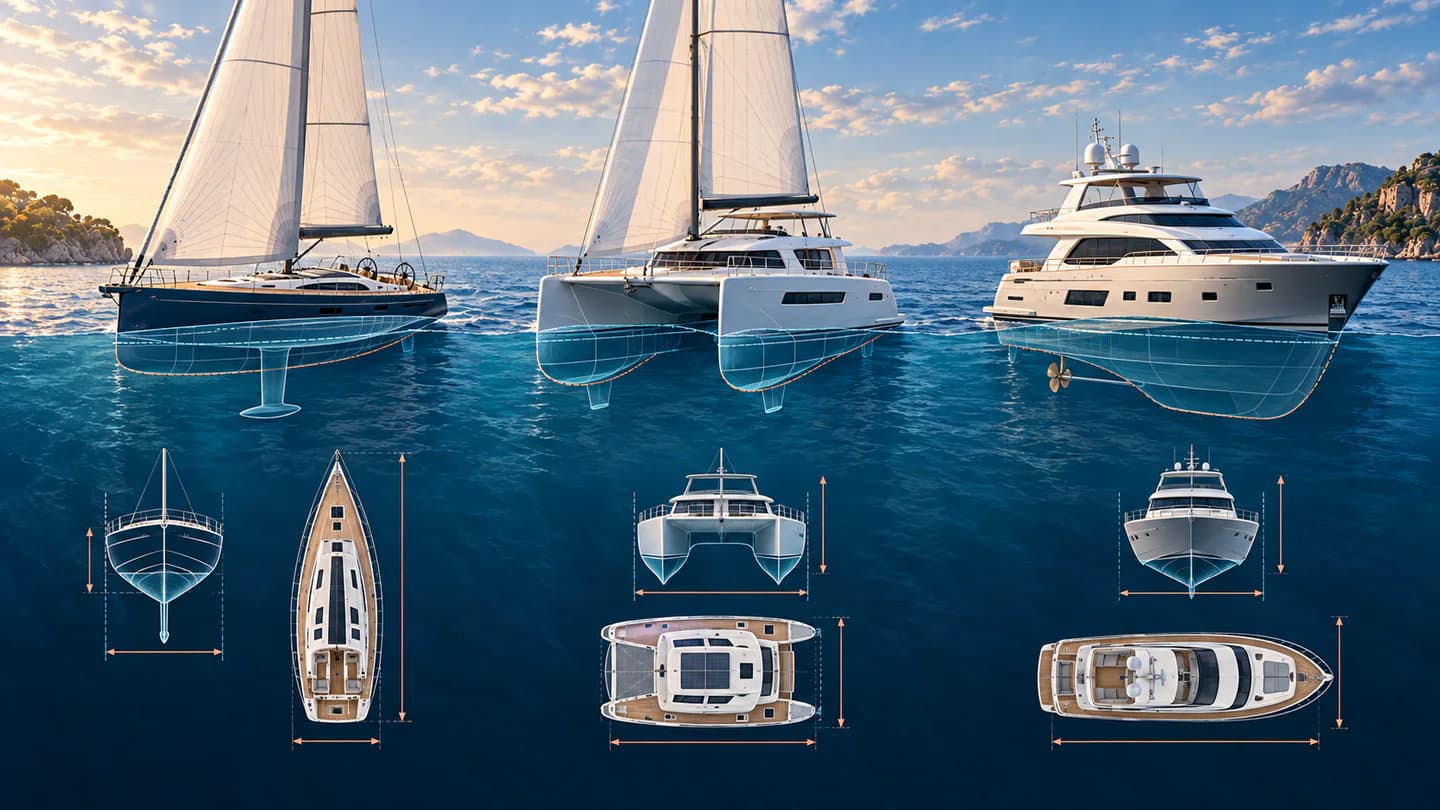
By Archimedes' principle, any floating object displaces a weight of water equal to its own weight. A boat floating at rest displaces exactly its own total weight in water. Displacement, therefore, is simply the total weight of the vessel — hull, rig, engine, fuel, water, stores, crew, and all equipment aboard.
In listing specifications, displacement is typically the light ship displacement — the weight of the boat in a standard, ready-to-sail condition without fuel, water, or stores. The fully loaded displacement (with full tanks and crew) will be higher. For a typical 40-foot cruising yacht with 200 litres of fuel, 200 litres of water, stores for two weeks, and two crew, the fully loaded weight could be 400–600kg above the light displacement figure.
Displacement is expressed in kilograms (kg) or metric tonnes (1 tonne = 1,000 kg). You may also see it expressed in pounds or long tons in American or British listings.
Light vs. Heavy Displacement
The most useful way to interpret displacement is not as an absolute figure but as a ratio relative to waterline length. The Displacement-to-Length Ratio (DLR) is a standard measure used to classify boats as light, moderate, or heavy displacement:
DLR = Displacement (in lb) ÷ (0.01 × LWL in feet)³
- Under 100 — Ultra-light. Racing boats, high-performance multihulls. Fast in light air, lively in a seaway.
- 100–200 — Light displacement. Modern performance cruisers, sportboats. Quick, sporty, lively motion.
- 200–275 — Moderate displacement. Most modern production cruising yachts. Good balance of speed and comfort.
- 275–350 — Heavy displacement. Traditional bluewater cruisers, offshore passage-makers. Comfortable, seakindly motion; slower in light air.
- Over 350 — Very heavy. Classic and traditional vessels. Excellent seakeeping; slow, requiring dependable wind.
This ratio is rarely provided directly in a listing but can be calculated from the stated displacement and LWL. It is a far more useful comparison tool than absolute displacement when comparing boats of different lengths.
What Displacement Tells You About Performance
Speed
Heavier boats are generally slower, particularly in light air. A light-displacement cruiser with a DLR of 150 will sail away from a heavy-displacement bluewater boat in a 10-knot breeze. In 25 knots of breeze and a big sea, the heavier boat may be more comfortable and no slower — because the lighter boat is surging and slamming while the heavier one is rolling steadily through the waves.
For powerboats, displacement directly determines the fuel cost of speed. Heavier displacement requires more power to achieve planing speed. A 10-tonne motor yacht needs significantly more power (and fuel) to reach 20 knots than a 5-tonne boat of the same length.
Motion in a Seaway
This is where displacement has the most practical impact on day-to-day comfort. A heavier, higher-displacement vessel has more momentum — it is harder to accelerate and harder to stop. In a seaway, this translates to a slower, more predictable rolling motion. Lighter vessels accelerate and decelerate rapidly with each wave, producing a snappier, quicker motion that many people find more exhausting and nauseating on long passages.
For bluewater sailing — long offshore passages, trade wind routes, ocean crossings — a moderate-to-heavy displacement boat is generally preferred for crew comfort. For coastal racing and daysailing in sheltered waters, light displacement boats offer exciting performance.
Load Carrying
A heavier displacement boat carries gear, stores, fuel, and water more gracefully than a light-displacement design. Adding 500kg to a heavy-displacement 15-tonne bluewater cruiser barely changes its trim; adding the same weight to a 4-tonne performance cruiser significantly changes its waterline and handling. For liveaboard use or extended offshore passages with large stores, heavier displacement designs are more forgiving.
Stability
Displacement contributes to stability — but it is not the only factor. The position of the centre of gravity (affected by keel depth and ballast weight) and the shape of the hull (beam, freeboard) together determine how a boat behaves when heeled. A heavy, beamy, shallow-draft boat with a high centre of gravity can be less stable than a lighter fin-keel boat with a deep lead keel. Displacement alone does not guarantee stability.
Motorboats: Displacement vs. Planing
For motorboats, displacement is more than just weight — it determines the entire propulsion philosophy:
- Displacement motorboats (trawlers, long-range motor yachts) cruise at 7–10 knots, driven by their hull speed. Their heavy displacement is an asset: it means a stable platform, excellent sea-keeping, and very efficient fuel consumption at low speed — often 3–8 litres/hour for a typical trawler yacht.
- Planing powerboats are designed to overcome displacement limitations by rising onto the plane at speed. This requires enormous power relative to weight. A 5-tonne express cruiser might need 400–600hp to reach 35 knots, burning 80–120 litres/hour at full throttle.
The displacement-to-power relationship is why running costs for fast powerboats are so dramatically higher than for displacement cruisers. See our guide on Total Cost of Boat Ownership for the full picture.
Practical Use When Reading Listings
When comparing two listings of similar LOA, the displacement figure tells you:
- Heavy boat (high displacement) — More likely to be a comfortable liveaboard or offshore passage-maker. Expect a more sedate motion, higher load capacity, more solid construction, and slower performance in light air.
- Light boat (low displacement) — More likely performance-oriented. Expect lively motion, faster speeds in light to moderate winds, less load-carrying tolerance.
Neither is inherently better — the right displacement for you depends on how and where you intend to sail. Browse all listings and filter by type to find vessels matched to your intended use, or read our Boat Types Explained guide to narrow down further.