
Annual Boat Maintenance Checklist
Introduction
A boat that is maintained to a schedule costs far less over its lifetime than one maintained reactively — where problems are only fixed when they fail. Proactive maintenance keeps the vessel safe, protects its value, and avoids the frustration of a breakdown at sea or a missed sailing season. This guide covers the key maintenance tasks organised by frequency: what to do every time you use the boat, each month, each season, and annually.
For the specific cost implications of each task, see Total Cost of Boat Ownership. Buyers evaluating a used boat should read this alongside our First-Time Buyer's Checklist to assess whether current maintenance is up to date.
Every Time You Use the Boat
- Check engine oil level — Before starting. Top up if needed; investigate if consistently dropping.
- Check coolant level — Cold engine only. A dropping level indicates a leak.
- Check bilge — Should be dry or nearly so. Any unexpected water should be investigated before departure.
- Check all seacocks are open (engine cooling water inlet, cockpit drains) before starting the engine.
- Check exhaust flow — Water-cooled exhausts should show a steady flow of water within 30 seconds of engine start. No water flow = overheating imminent; shut down immediately.
- Check navigation lights — Test before any night passage.
- Check weather forecast — Not strictly mechanical, but the most important pre-departure check of all.
Monthly (or Every 25 Engine Hours)
- Run the engine under load — Even if not sailing, run the engine in gear for at least 20–30 minutes to keep seals lubricated, batteries charged, and the raw water system circulating. An engine that sits unused for months deteriorates.
- Operate all seacocks — Turn each seacock through its full range (open to closed and back). Seacocks that are never operated seize in the open position — a serious safety hazard.
- Check battery voltage — Both engine start and domestic battery banks. A resting voltage below 12.4V on a 12V system indicates a depleted battery.
- Check bilge pump operation — Test both manual and electric pumps. Test the automatic float switch by lifting the float manually.
- Check fuel and water levels — Top up fuel before storage to prevent condensation in tanks.
- Inspect dock lines and fenders — Replace chafed dock lines and re-position fenders as needed.
- Run the windlass — Cycle it up and down briefly to keep the motor and gearbox lubricated.
- Check hatches and portlights for leaks — Reseal any that are weeping, before water ingress causes deck core damage.
Each Season (Spring Commissioning)
Engine and Propulsion
- Full engine service — Oil and oil filter, fuel filter, raw water impeller, belts, and coolant check. This is the single most important seasonal task. See Diesel Engine Maintenance Basics for detail.
- Check the raw water impeller — Replace annually regardless of condition. A failed impeller will destroy the heat exchanger within minutes of overheating.
- Check the stern gland or shaft seal — Should drip a few drops per minute when running (traditional stuffing box) or be dry (dripless seal). Adjust or repack if needed.
- Check the cutlass bearing — Worn bearings cause shaft vibration. Replace if worn.
- Service the saildrive (if fitted) — Check the oil in the saildrive leg. Inspect the rubber bellows for cracking or perishing — replace immediately if deteriorated.
- Check propeller — Inspect for ding damage and check zincs on the shaft and prop.
Rigging (Sailboats)
- Inspect standing rigging — Carefully examine every swage terminal for cracking, every toggle for elongation, every clevis pin for wear. Look for broken strands ("meat hooks") in wire rigging.
- Inspect the mast and boom — If the mast is unstepped for winter, inspect fittings, sheaves, and wiring at the masthead. If stepped, ascend the mast or use a camera on a halyard.
- Check all blocks, clutches, and winches — Disassemble and service winches annually (grease and oil the pawls and springs). Seized winches are common and inexpensive to fix.
- Check furling systems — Inspect headsail and mainsail furling drums for smooth operation. Lubricate foil bearings.
- Inspect sails — Check panels for UV degradation, seam separation, and batten pocket wear. Note any repairs needed.
Hull and Deck
- Antifouling — Apply fresh antifouling paint before launch. See our dedicated guide: Antifouling: What It Is and When to Do It.
- Inspect all through-hull fittings — Check for corrosion and dezincification. Replace any suspect fittings during haul-out.
- Polish and wax topsides — Protects the gelcoat from UV and salt degradation.
- Check keel bolts — Inspect from inside the boat for rust staining or weeping. Any movement in the keel is a serious issue requiring immediate professional attention.
- Check deck fittings — Press around all stanchion bases, cleats, winch bases, and chainplates for soft spots indicating water ingress into the deck core.
Safety Equipment
- Life raft — Check service date label. Service if due or if within 12 months of service interval.
- EPIRB — Check battery expiry and that registration details are current.
- Flares — Check expiry dates. Replace any out of date.
- Fire extinguishers — Check charge indicator and service date.
- Life jackets — Service auto-inflation mechanisms, check oral tubes and bladder for leaks.
- Jackstays and tethers — Inspect webbing for UV degradation and stitching for wear.
- First aid kit — Check contents against your checklist, replace expired medicines.
Electrical Systems
- Test all electronics — Chart plotter, VHF, AIS, autopilot, instruments. Update chart software if needed.
- Inspect battery condition — Load-test batteries and replace any that fail. A domestic battery bank over 4–5 years old should be assessed.
- Check all connections — Clean corroded terminals with electrical contact cleaner.
- Test bilge pump float switch — Critical for unattended protection.
Annually (Haul-Out Tasks)
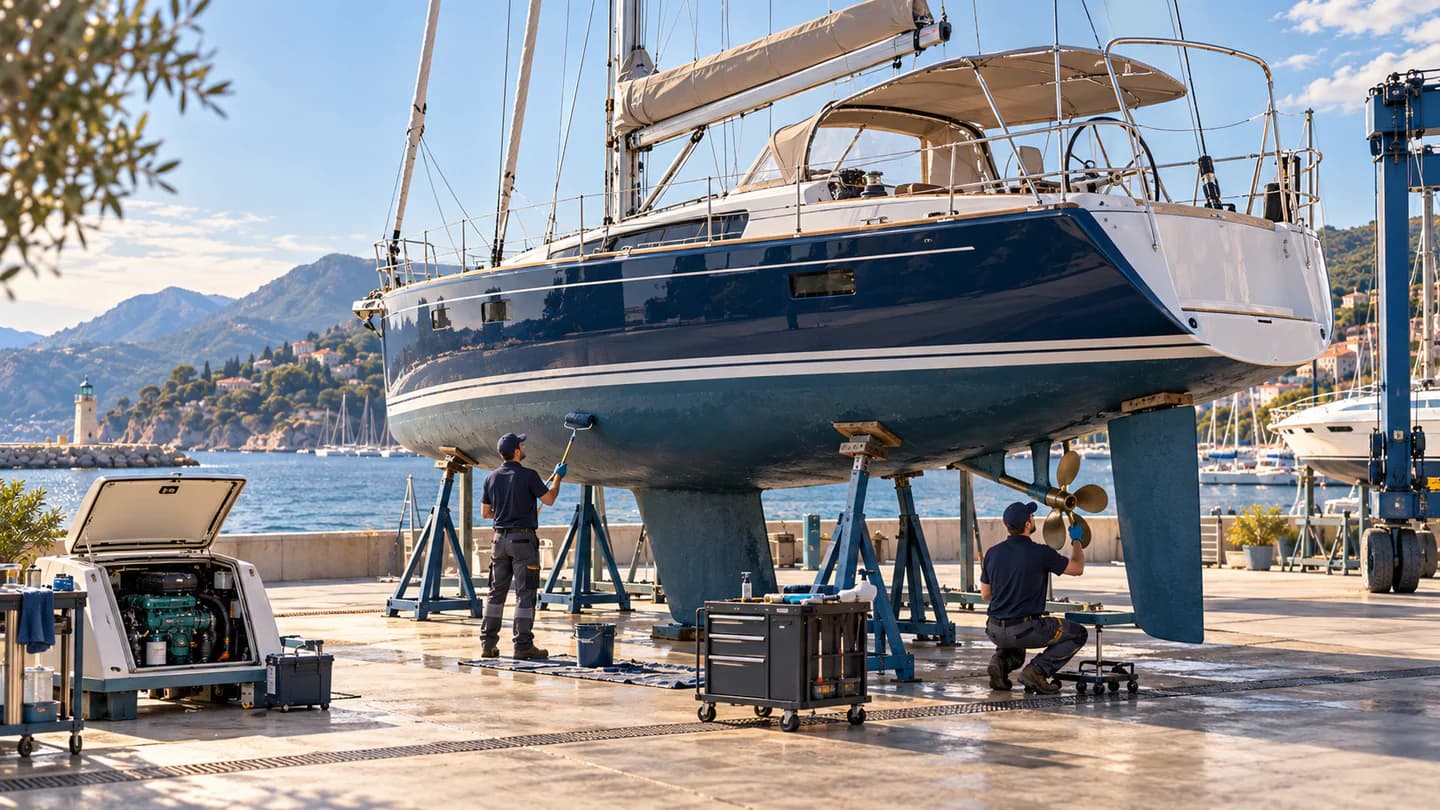
Even if your boat is not antifouled every year, a haul-out inspection every 1–2 years is strongly recommended:
- Hull inspection — Check for osmosis blisters, impact damage, and condition of the gelcoat below the waterline.
- Keel inspection — Inspect the keel-to-hull joint, keel bolts, and keel surface.
- Propeller and shaft inspection — Check for blade damage, electrolytic corrosion, and shaft straightness.
- Through-hull fittings and seacocks — Inspect and service all fittings out of the water.
- Sacrificial anodes — Replace hull zincs if more than 50% consumed.
- Rudder inspection — Check for play in the rudder bearings; tap the blade to check for delamination.
Every 5 Years
- Full standing rigging replacement (sailboats) — Wire rigging older than 10 years is past its safe service life regardless of appearance.
- Saildrive bellows replacement (if fitted) — Do not exceed 7 years.
- Fuel tank inspection — Check for internal corrosion (steel tanks) or crazing (plastic tanks). Have tanks professionally cleaned if significant contamination is found.
- Seacock replacement — Older bronze seacocks should be replaced before they seize or fail.
- EPIRB replacement or battery replacement — Battery life is typically 5 years.
- Life raft replacement or overhaul — Major life raft service schedules vary; check manufacturer guidance.
Keeping Records
A maintenance logbook is one of the most valuable documents a boat owner can keep — and one of the first things a serious buyer will ask to see. Log every service with the date, what was done, and what parts were used. Keep all receipts. A well-documented maintenance history adds real monetary value when selling and gives you confidence that nothing important has been overlooked.
When buying a used boat, the presence of a thorough maintenance log is a strong positive indicator. Its absence is a reason for heightened scrutiny during the marine survey.