
How to Write a Great Boat Listing
Introduction
Your listing is the first — and often only — impression a buyer will have of your boat. Most buyers shortlist boats entirely based on what they see online. A listing with poor photos, a thin description, or missing specifications will be passed over for one that gives buyers the confidence to pick up the phone. This guide shows you how to create a listing that stands out, builds trust, and generates serious enquiries.
How Our Listing System Works
On our platform, listings are structured into areas — sections that represent different parts of the boat. Every listing requires at least a General area, which gives an overview of the vessel. Most sellers also add separate areas for key sections: Engine & Propulsion, Sails & Rigging, Navigation & Electronics, Interior & Accommodation, and any other relevant section. Each area has its own description and photo gallery.
This structure makes your listing easy to navigate — a buyer can jump straight to the engine section to check hours, or to the electronics section to assess the navigation equipment, without wading through a wall of text. Well-organised listings with good area structure consistently generate more enquiries than those with a single block of text and a few photos.
Essential Specification Fields
Complete every specification field accurately. Buyers filter listings by these fields — an incomplete spec means your boat may not appear in relevant searches. Critical fields include:
- Make and model — Use the official manufacturer name and model designation.
- Year built — The hull completion year, not the year you purchased it.
- LOA — Length overall in metres or feet.
- Beam — Maximum beam in metres or feet.
- Draft — Maximum draft (for sailboats with lifting keels, state both maximum and minimum).
- Displacement — In kilograms or tonnes.
- Engine make, model, and hours — Be specific. "Yanmar 4JH45" is more useful than "Yanmar diesel."
- Fuel type and tank capacity
- Sail area (for sailboats)
- Keel type (for sailboats)
- Berths and heads
- VAT paid status (in Europe)
- Location — The marina, harbour, or region where the boat is currently located.
- Asking price and currency
Writing the General Description
The General area description is your main sales pitch. It should give a buyer a clear picture of what the boat is, why it's a good choice for its intended use, and why it's worth the asking price. A good general description covers:
Opening Paragraph — The Hook
Lead with the most compelling aspect of the boat. Is it a well-found offshore cruiser with an outstanding maintenance record? A fast coastal racer in exceptional condition? A liveaboard-ready bluewater passage-maker? Buyers scan dozens of listings — your opening paragraph needs to tell them immediately whether this is worth reading further.
Good example: "A rare opportunity to acquire a well-maintained 2012 Hallberg-Rassy 48 with a full bluewater fit-out, new standing rigging (2023), and over 30,000 offshore miles under her keel. Based in Palma de Mallorca and ready to sail."
Weak example: "Lovely yacht in good condition. Well looked after with lots of extras. Viewing recommended."
History and Ownership
Buyers value transparency. Include:
- Number of previous owners
- How the boat has been used (coastal cruising, offshore passages, racing, charter)
- Notable voyages or achievements if relevant
- Whether service records are available
Recent Investment and Upgrades
List significant improvements made during your ownership, with approximate dates:
- "New Yanmar 4JH57 engine installed 2021 (currently 340 hours)"
- "Standing rigging replaced by Selden in 2022"
- "New North Sails main and genoa 2023"
- "Raymarine Axiom 12 chart plotter and Quantum radar installed 2022"
This is your evidence that the boat has been properly cared for and justifies your asking price.
What's Included
Be explicit about what is included in the sale. Buyers assume everything listed is included unless you state otherwise. If anything significant is excluded (a tender, for example, or a particular piece of electronics), say so clearly.
Area Descriptions: Go Into Detail
Each area section should be thorough. Here's guidance by area:
Engine & Propulsion Area
- Full engine specification: make, model, year, power (hp/kW), current hours
- Fuel type, tank capacity
- Drive type (shaft, saildrive, outboard, stern drive)
- Propeller: fixed, feathering, or folding
- Last service date and what was done
- Any recent major work (impeller, heat exchanger, injectors)
- Generator if fitted (make, model, hours)
Sails & Rigging Area (Sailboats)
- Rig type and mast manufacturer
- Standing rigging: material (wire or rod), age/year replaced
- Running rigging: general condition and when last renewed
- Furling systems: brand, condition
- Sails: list each sail with age, condition, and maker if known (main, genoa, staysail, spinnaker, storm sails)
- Sail covers and lazy bag condition
Navigation & Electronics Area
Buyers care about the electronics package. List every item:
- Chart plotter(s) — brand, model, screen size, year
- AIS — class B or A, integrated or standalone
- VHF radio — fixed and/or handheld, DSC capability
- Autopilot — brand, model, tiller or wheel drive
- Radar — brand, model, dome or open array
- Wind instruments — brand and condition
- Depth sounder
- EPIRB — make, model, registered, battery expiry
- Life raft — make, capacity, service date
- Satellite communication (Iridium, Starlink) if fitted
Interior & Accommodation Area
- Layout description: number of cabins, saloon configuration, galley layout
- Number of berths and which are comfortable for sea passage
- Number of heads and type (manual/electric, with/without holding tank)
- Galley equipment: stove type (gas/electric), oven, refrigeration
- Heating: diesel cabin heater, electric, forced air
- Fresh water capacity and watermaker if fitted
- Overall interior condition and any recent refurbishment
Photography: The Most Important Element
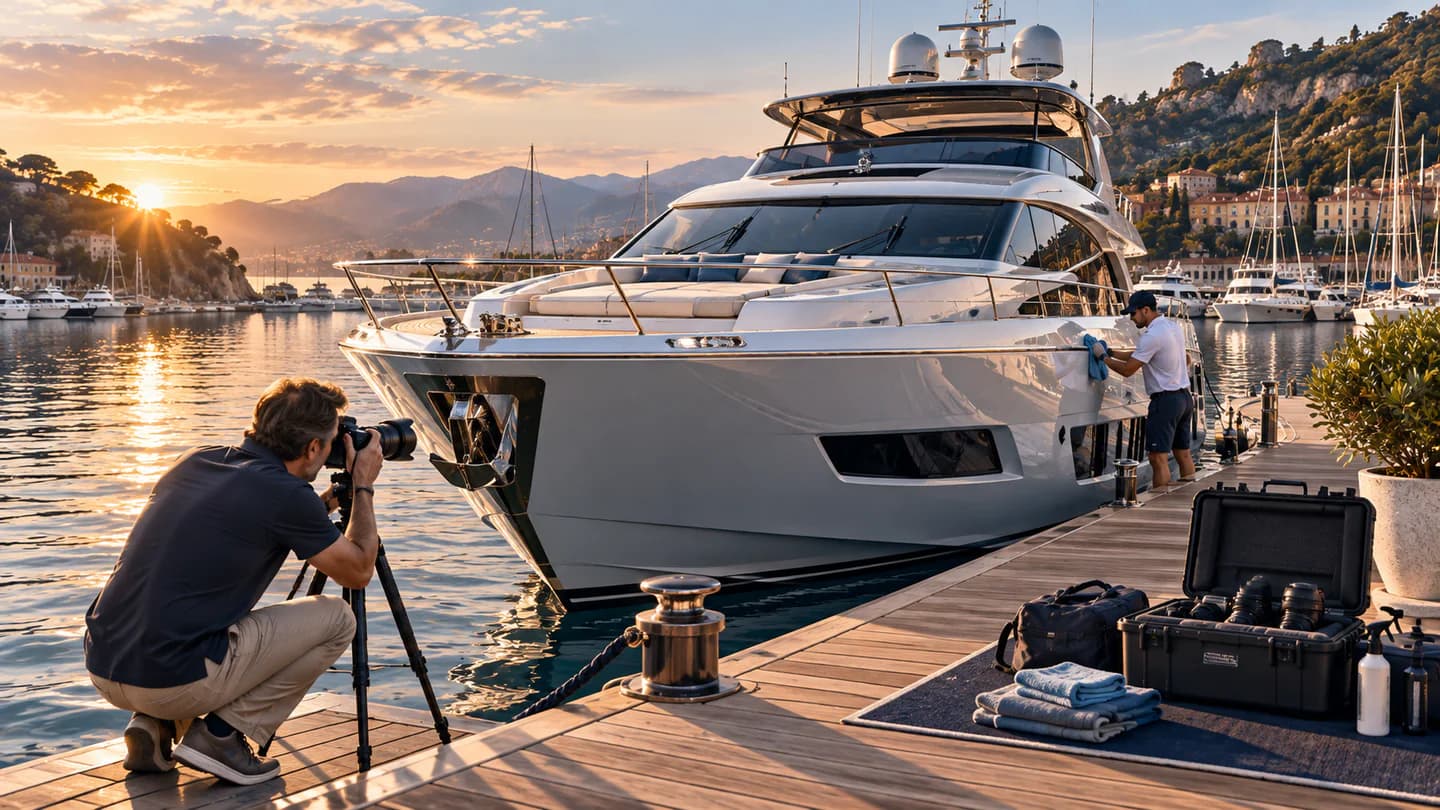
Photos sell boats. A listing with 5 poor photos will generate a fraction of the enquiries of one with 20 professional shots. On our platform, each area has its own gallery — use this structure to organise your photos clearly.
How Many Photos?
For a cruising yacht, aim for at least 20–30 photos distributed across areas. More is better. Buyers will scroll through every photo before deciding whether to enquire — don't leave them wondering what's behind a door.
Essential Shots
- Exterior: both sides, stern, bow, at anchor or on a mooring (most attractive)
- Cockpit: helm position, winches, traveller, binnacle
- Saloon: multiple angles showing the full space
- Galley: stove, refrigerator, counter space
- Each cabin: forward and aft cabins, heads
- Chart table and navigation station
- Engine bay: clean and well-lit — a tidy engine bay reassures buyers
- Sails: hoisted if possible
- Rigging: looking up the mast from deck
- Electronics panel: instruments and chart plotter powered on
- Any notable extras: watermaker, generator, solar panels, radar
Photography Tips
- Use natural light — open hatches and portlights to brighten the interior. Shoot on a sunny day if possible.
- Clean before you shoot — there should be nothing on counters, berths, or in the cockpit that shouldn't be there.
- Shoot wide — a wide-angle lens (or the ultra-wide mode on a modern smartphone) makes spaces look their best.
- Avoid clutter — remove fenders, dock lines, random gear from the cockpit for exterior shots.
- Shoot the boat on the water — not sitting in a cradle in a dry boatyard if avoidable.
- Don't use the boat's interior photos from the manufacturer's brochure — buyers know the difference and it destroys trust.
Our platform supports image reordering within each area — put your best, most impactful photo first in each section.
Honesty and Disclosure
Disclose known issues in the listing. This is not weakness — it is professionalism. Buyers who discover undisclosed problems during a survey will use them aggressively in negotiation, may withdraw entirely, and the relationship becomes adversarial. Buyers who see a forthright disclosure of a minor issue in the listing trust the seller and are more likely to proceed. The disclosure can be brief: "The standing rigging is original and will require replacement before offshore use, reflected in the pricing."
Pricing and Contact
- State a clear asking price in the appropriate currency.
- State "VAT paid" or "VAT not paid / VAT status unknown" explicitly.
- Note whether the price is negotiable ("offers considered" or "price firm") if you have a strong preference.
- Ensure your contact details and response method are correct — buyers who cannot reach you move on.
After Publishing: Review Your Listing
Once your listing is live on our platform, view it as a buyer would. Ask yourself honestly: would you enquire about this boat based on what you see? If the answer is not an immediate yes, identify what's missing and improve it. Listings can be edited and updated at any time after publication.